

Why 8VC invested in Orca Bio
Why We Invested Collection
- Discover how 8VC and Orca Bio are transforming bone marrow transplants with innovative cell therapies.
- This blog highlights their efforts to enhance treatment options and accessibility for cancer patients, reshaping the future of BMT and improving patient outcomes.

8VC invested in Orca Bio to revolutionize bone marrow transplants with novel cell therapy, addressing chronic issues and expanding treatment options for cancer patients.
About 8VC
8VC aims to transform the technology infrastructure behind many industries.
- San Francisco, California, United States
- 51-100
- Venture Capital
- Early Stage Venture, Late Stage Venture, Seed
- www.8vc.com
About Orca Bio
Orca Bio is a clinical-stage cell therapy company dedicated to delivering curative medicine to patients.
- Menlo Park, California, United States
- 101-250
- Series D
- Private
- www.orcabio.com
Key Learnings
The key learnings are:
- Transformative Investment in Bone Marrow Transplants:8VC’s investment in Orca Bio aims to transform bone marrow transplants with novel cell therapy, addressing chronic issues and expanding treatment options for cancer patients. Orca Bio’s innovative approach combines advanced engineering and biological innovations, enhancing treatment efficacy and patient outcomes. Their work focuses on developing cell-transplantation therapies that replace conventional BMTs, which have remained largely unchanged since the 1950s.
- Focus on Technology Infrastructure:8VC focuses on transforming the technology infrastructure behind various industries. By investing in early and growth-stage companies, they aim to drive innovation and create impactful solutions that enhance industry operations and consumer experiences. Their partnership with Orca Bio aligns with this mission, leveraging cutting-edge technology to revolutionize cancer treatment.
- Addressing Bone Marrow Transplant Challenges:Orca Bio tackles the significant drawbacks of conventional BMTs, such as high failure rates and severe side effects. Their innovative approach involves identifying a precise cocktail of immune cells that balances the trade-off between transplant rejection and therapeutic efficacy. This reduces rejection rates, increases survival, and expands the patient pool, making the therapy more accessible and effective.
- Current BMT Protocols: Hope and Caution:Despite BMT’s long-standing usage, it remains a grueling and involved process with major risks for patients. Orca Bio’s cellular products are the first precision cell therapies to enter the clinic as replacements for conventional BMTs. These products are designed to substantially reduce the likelihood of dangerous adverse events, offering safer and more effective treatment options.
- Engineering Meets Stem-Cell Research:Orca Bio exemplifies the integration of complex engineering with fundamental science. Their proprietary OrcaSorter platform enables clinical-grade sorting of complex cell products, advancing the commercialization of stem-cell and transplant biology innovations. This platform meets the rigorous requirements for producing optimal cell therapy products, driving exponential improvement in the broader field of cell therapy.
Why 8VC invested in Orca Bio
Every year in America, roughly 23,000 people undergo a Bone Marrow Transplant (BMT). These procedures are typically last-line interventions to save cancer patients. When successful, the therapy is often curative.
Despite its value, a BMT is an arduous procedure with significant drawbacks. The transplants can fail to engraft, have extreme side effects even when successful, and if rejected can ultimately result in death.
The most pernicious issue is that BMTs cannot scale to the multitudes of patients who need them. BMT standards of care have been in place since the 1950s, with minimal progress in safety, efficacy, or reach.
Orca Bio is solving these issues by developing a novel cell-transplantation therapy that replaces conventional BMTs. Their work draws upon fundamental innovations in both engineering and biology.
The engineering innovation is a proprietary cell-sorting method that surpasses incumbent technology in both throughput and precision.
The biological innovation is the identification of a precise cocktail of immune cells that balances the trade-off between transplant rejection and therapeutic efficacy.
Together, these advances allow Orca to generate therapies with the potential to reduce rejection, increase survival, expand the patient pool, and treat new diseases.
8VC is excited to partner with Orca’s founders Ivan Dimov, Nate Fernhoff, and Jeroen Bekaert, and to announce our investment in the Series C and Series D rounds of Orca Bio: “Orca Bio Emerges With Nearly $300 Million to Transform Allogeneic Cell Therapy.”
This funding enables Orca to bring their innovative therapies to patients, including via their ongoing Phase 1 and Phase 2 clinical trials.
Current BMT protocols
At 8VC, we have long-embraced the idea that cells are the third major wave of therapeutic modalities. In our piece, “Why cells have the hidden power to save thousands of lives,” Joe and Francisco outline the coming era of therapies harnessing the unique capabilities of naturally occurring cells.
It was a straightforward development in our minds to apply that focus to BMT, as conventional BMTs were the first cell therapies to gain widespread adoption.
Despite BMT’s long-standing usage, it is such a grueling and involved process that it carries major risks for patients.
The procedure generally comprises two main steps:
- a conditioning regimen where high doses of cancer drug deplete both active cancer and the patient’s immune system, followed by
- an infusion of immune and stem cells to reconstitute the patient’s now-damaged immune system.
- For some patients, step 3 is performed using the patient’s own cells, known as an autologous transplant. However, autologous transplants carry a significant risk of relapse associated with using the patient’s own, cancerous cells. Many BMTs performed in the US, and nearly all the transplants for leukemia, are instead allogeneic, where the infusion comes from a separate donor selected on the basis of genetic similarity to the recipient.
Allogeneic transplants require the availability of a donor who is a suitable genetic match, but offer the advantage that the donor immune cells protect against residual cancer in the patient while the patient’s immune system is reconstituting itself.
This benefit is known as the Graft versus Tumor (GVT) effect. It comes, unfortunately, with high risk — the donor immune system can also attack the recipient’s healthy cells and cause Graft versus Host Disease (GVHD).
Patients are forced to accept the prospect of GVHD to ensure a robust GVT response that guards against cancer relapse.
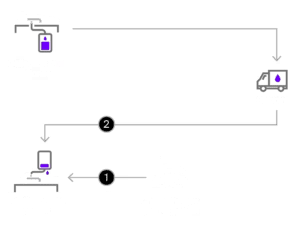
With the intricacies of donor selection, cell harvesting, and transplant grafting, allogeneic BMTs have proved challenging to improve. As a result, the benefits of the procedure have stayed flat over the past several decades, with adult acute myeloid leukemia (AML) patients seeing only a 49% three-year survival rate post-transplant, up just 8% since the turn of the century[1].
The risks likewise remain significant. Within 100 days of the transplant, up to 70% of patients experience acute GVHD, and up to 40% experience chronic GVHD[2].
Such low patient survival and high complication rates derive from the complex interplay between the disease and the treatment. Patients are at risk of toxicities associated with the transplant as well as the risk that their cancer will return.
Orca’s cellular products are the first precision cell therapies to have entered the clinic as replacements for conventional BMTs.
Each dose is made on Orca’s proprietary manufacturing platform, which selects immune cells with single-cell precision to assemble an optimal mixture of cell types for the cellular product.
These cell mixtures offer the capacity to advance on the curative capabilities of conventional BMTs by substantially reducing the likelihood of dangerous adverse events.
Their first two assets are already in trials as replacements for conventional allogeneic BMTs in patients with AML and acute lymphoblastic leukemia (ALL). TRGFT-201 is a regulatory T-cell-based cell product in Phase 2. OGFT-001 is a next-generation, fully controlled cell product in Phase 1.
Both therapeutic candidates have the potential to deliver curative outcomes for highly at-risk cancer patients.
Incumbent cell-sorting technology
Orca’s efforts are built largely on Ivan and Nate’s work in Irv Weissman’s lab at Stanford University. Fundamental research in the Weissman Lab investigated immune reconstitution and balancing the differential effects of GVHD and GVT in conventional T-cell-replete transplants to improve outcomes.
These studies established that purified, T-cell-depleted transplants could prevent relapse in autologous transplants and reduce GVHD in allogeneic ones. In the early ’90s, Weissman spun out that research into the company SyStemix [3].
While SyStemix had promising early results, it was acquired and ultimately shelved by Novartis amid challenges associated with scalable manufacturing.
Further work cemented the core concepts underlying Orca’s cell therapy products, notably the characterization of additional cell types that could be paired with hematopoietic stem cells (HSCs) to introduce a GVT effect without the alloreactivity of the cells in conventional BMTs that cause GVHD.
Based on that academic work, Orca knew what an ideal cellular product might look like. However, manufacturing the therapy at clinical scale remained infeasible with existing technologies.
Production of an optimized cell therapy product to replace conventional BMTs required a cell sorting system capable of correctly sorting the 100B cells a donor can provide, selecting the cancer-fighting cells and eliminating the ones that induce toxicity.
In addition to processing the graft with extremely high accuracy, an effective platform needed to operate at very high speeds, keeping within strict time parameters so the cells stay healthy.
Contemporary sorting technologies carried an inherent trade-off between the purity and the throughput of the sorting, making production impossible for clinical applications. Fluorescence-activated cell sorting (FACS) can achieve high purity, but at the costs of high cell loss and low throughput.
In addition, FACS devices are not sterile, which makes them extremely challenging to deploy in a clinical setting. Magnetic-activated cell sorting (MACS) devices, by contrast, are sterile and capable of sufficiently high-throughput sorting, but cannot achieve the necessary levels of purity to improve upon conventional BMT.
These limitations had persisted despite many attempts at innovation in the field over the preceding decades, with no new devices having pushed beyond academia into meaningful commercial traction.
Stem-cell research
Our Bio-IT thesis is built around the view that complex engineering is increasingly enabling fundamental science. Orca exemplifies these principles precisely. Ivan and Nate synthesized an engineering mindset with the history of research on what would constitute an ideal cell transplant product.
Motivated to advance a previously stagnant area, they created the OrcaSorter, a proprietary platform capable of clinical-grade sorting of complex cell products.
The OrcaSorter is uniquely able to meet the rigorous requirements for producing optimal cell therapy products, enabling the commercialization of academia’s fundamental advances in stem-cell and transplant biology.
Specifically, it is a sterile device that can perform high-purity sorting at the high throughputs needed for clinical deployment.
The heart of the approach is suspending cells rather than flowing them, and using a high-speed laser to select the individual cells for the end cell therapy product.
We believe the OrcaSorter can drive exponential improvement in the broader field of cell therapy beyond replacing conventional BMTs.
It can enable the commercialization of any cell therapy requiring a high degree of purity, and offers particular advantages for therapies for which a rare cell type is largely responsible for driving clinical outcomes.
We see these capabilities as positioning Orca to become a major, large-cap pharmaceutical company built around this third wave of therapeutics: cell therapies.
Orca’s future
Orca’s cellular products provide immediate-term opportunities to expand on the applicability of conventional BMTs, addressing currently unmet needs in blood cancers, genetic disorders, and other indication areas.
If TRGFT-201 and OGFT-001 improve survival and reduce toxicity, more AML and ALL patients could potentially be treated earlier in the course of disease without fear of exposing them to the heightened risks conventional BMT carries.
Less GVHD could further loosen genetic matching requirements, expanding the pool of suitable donors for patients who would otherwise be unable to find a clinically acceptable match.
With high-purity sorting, autologous BMTs could be replaced with new cell products that are safe, and reduce the likelihood of relapse.
Within genetic disorders, Orca’s cellular therapy products should have much lower rates of toxicity, allowing expansion into diseases that are not life-threatening.
Outside of replacing conventional BMTs in blood cancers and genetic diseases, there are several promising indication areas that could benefit from the use of Orca’s cellular products.
In the context of CAR T-cell therapies, research has shown improved outcomes when following a CAR T-cell course with a conventional BMT[4].
By combining CAR T cells with Orca’s cellular products instead, Orca could expand treatment options for these patients, given the toxicity and matching limitations of conventional BMTs.
In the near future, autoimmune disorders present a compelling opportunity for Orca’s therapies to “reboot” the immune system.
Conventional BMTs are already being evaluated in MS and severe Crohn’s disease, and Orca could supplant BMTs, offering lower risks. BMT has even shown success in limited cases for HIV patients — bringing Orca’s cellular products to that area could potentially lead to transformative, curative therapies.
Conclusion
Orca embodies what we look for in a platform-based biotechnology company.
They have developed robust, enabling infrastructure that generates a vast pipeline of clinical opportunities, are led by a top team of scientists and engineers, and are addressing a clear market need that de-risks both the therapeutic modality and the platform.
We are thrilled to partner with Orca to usher in the next wave of life-saving cell therapies and to help build a generational cell therapy company.
Want to keep reading?
You can read the rest of “Why we invested in” collection here:






Comments (0)
There are no comments yet :(