

Nike's 1970 Manifesto: The Rebel Spirit That Forged a Global Giant
Interesting Memo
Few documents have captured the zeitgeist of a company’s formative years quite like Nike’s 1977 manifesto- because it is short and easy to read!
Penned by executive Rob Strasser, these 10 principles emerged at a pivotal moment, when the fledgling Blue Ribbon Sports faced a $25 million tariff bill that threatened its existence.

Introduction
In 1977, Nike stood at a crucial crossroads. Still known as Blue Ribbon Sports, the company faced a potentially devastating $25 million tariff bill from the federal government. Against this backdrop of existential threat,
Nike executive Rob Strasser penned a list of 10 principles that would come to embody the company’s rebellious spirit and drive its meteoric rise in the following decades.
The Genesis of a Corporate Rebellion
- A Company on the Brink
- 1977 revenue: $28.7 million; fewer than 1,000 employees
- $25 million tariff bill looming like a corporate Sword of Damocles
- Air technology and Jordan partnership still glimmers in an uncertain future Context: This financial precipice mirrors many startups’ “valley of death,” where vision collides with fiscal reality.
- Rob Strasser: The Architect of Attitude
- Key executive who later ironically bolstered Nike’s arch-rival, Adidas
- Hailed as “The man who saved Nike” by Willamette Week in 1985
- Known for a personality as bold as the manifesto itself Context: Strasser embodies the “intrapreneur,” an internal change agent whose impact often transcends organizational boundaries.
- The Manifesto’s Raison d’Être
- A rallying cry to realign with core values amid existential threat
- Unofficial doctrine that became official ethos
- A distillation of Nike’s scrappy, defiant DNA Context: This document serves as a case study in how informal corporate communications can shape formal culture.
The Principles: A Blueprint for Disruption
- Embracing Perpetual Revolution
- “Our business is change” – a prescient nod to future innovations
- Foreshadowed Nike’s ability to ride waves of cultural and technological shifts Context: This principle aligns with Schumpeter’s concept of “creative destruction” in business evolution.
- The Offensive as Corporate Doctrine
- “We’re on offense. All the time.” – A mantra that still echoes in Nike’s halls
- Shifts the paradigm from reactive to proactive market engagement Context: This aggressive stance reflects Sun Tzu’s Art of War applied to modern business strategy.
- Results Over Process: The Nike Way
- “Perfect results count — not a perfect process”
- Catapulted revenue from $28.7 million to $270 million in just three years Context: This principle challenges traditional management theory that often prioritizes process optimization.
- Business as Combat: The Competitive Edge
- “This is as much about battle as about business”
- Framed market competition in militaristic terms, galvanizing the organization Context: This metaphor taps into primal competitive instincts, a powerful motivator in high-stakes business environments.
- Innovation as Rebellion
- “Break the rules; fight the law”
- Spawned a culture of disruptive innovation in products and marketing Context: This ethos aligns with Clayton Christensen’s theory of disruptive innovation, positioning Nike as a perpetual industry disruptor.
- Resourcefulness as Virtue
- “Live off the land” – A call for creative resource management
- Instilled a culture of ingenuity and efficiency Context: This principle echoes the “bricolage” concept in entrepreneurship theory, emphasizing resource maximization.
The Manifesto’s Enduring Impact:
- A Cultural Lodestone
- Ex-employees treasure copies decades later, a testament to its resonance
- Articulates the shared purpose that defines Nike’s corporate identity Context: The manifesto’s longevity demonstrates the power of well-crafted corporate narratives in building lasting cultures.
- The Evolution of Corporate Ethos
- 2001: Expansion to 11 “Maxims”
- 2018: Distilled to 5 core principles, retaining the original aggressive spirit Context: This evolution reflects how foundational values can adapt to changing business landscapes while maintaining core identity.
- The Human Cost of Greatness
- Strasser’s move to Adidas created an irreparable rift with Phil Knight
- Illustrates the personal toll of fierce corporate competition Context: This personal drama underscores the often-overlooked human element in the pursuit of business excellence.
Conclusion
Strasser’s 1977 manifesto is more than a historical curiosity; it’s a blueprint for corporate rebellion that transformed an industry. Its principles of embracing change, maintaining an offensive posture, and pushing boundaries continue to resonate in today’s fast-paced business environment. For contemporary leaders, Nike’s manifesto offers a compelling case study in the power of corporate culture to drive growth and innovation.
As we navigate an era of unprecedented change and disruption, the Nike manifesto challenges us to consider: How can we instill a similar sense of purpose and rebellion in our organizations? What principles will define our legacy? In the end, Nike’s early rallying cry remains a testament to the enduring power of a bold vision, artfully articulated and fearlessly pursued.
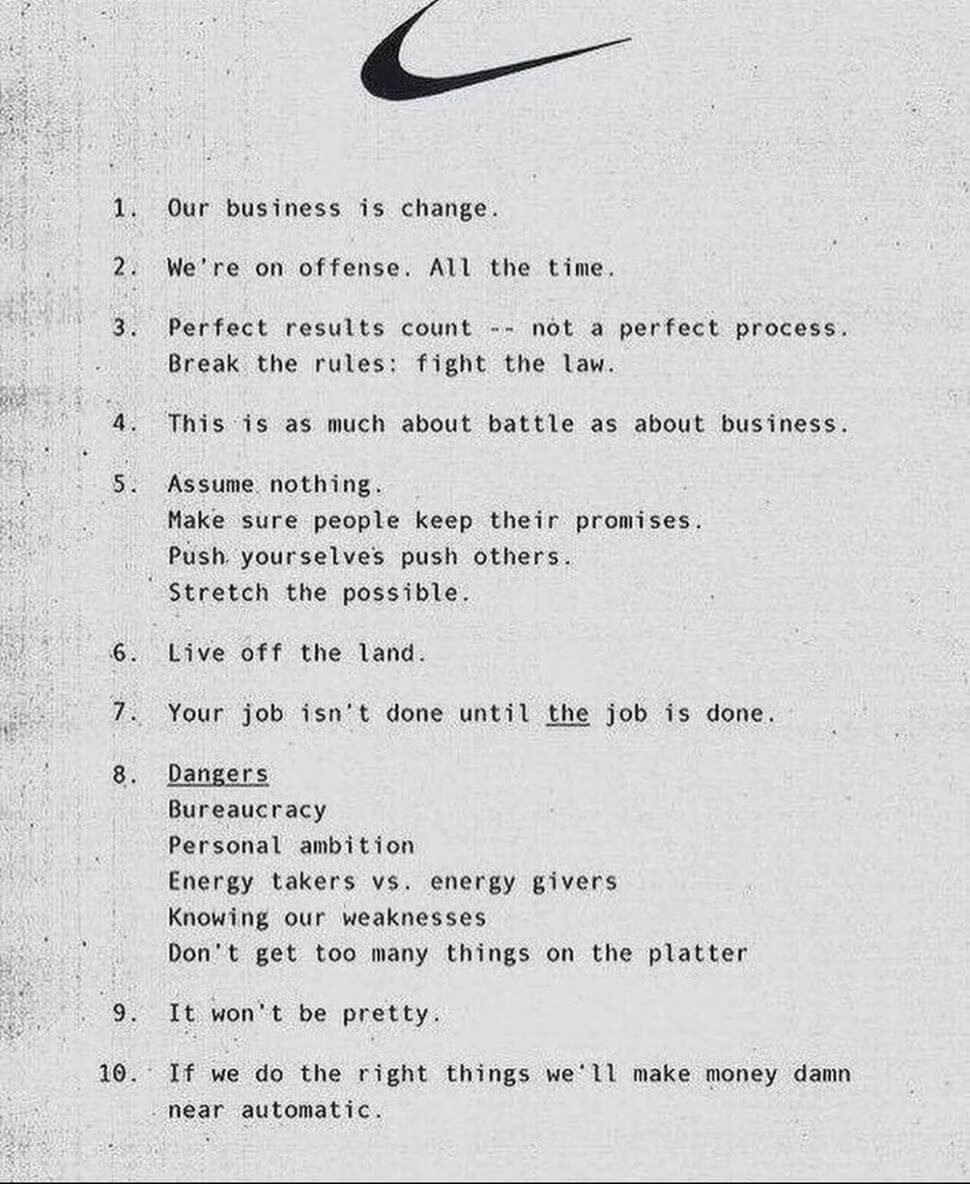
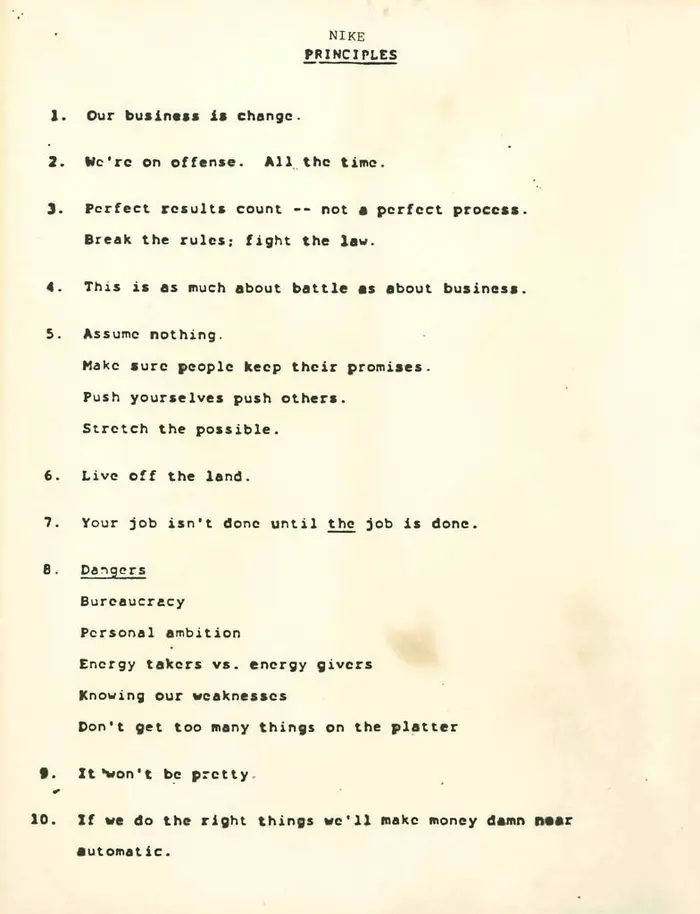
Nike Memo Images
I found two images. I’m inclined to think the ghetto-looking one is the orginal.
Pretty one
Ghetto one
Nike Memo
- Our business is change.
- We’re on offense. All the time.
- Perfect results count — not a perfect process. Break the rules: fight the law.
- This is as much about battle as about business.
- Assume nothing.
- Make sure people keep their promises.
- Push yourselves push others.
- Stretch the possible.
- Live off the land.
- Your job isn’t done until the job is done.
- Dangers
- Bureaucracy
- Personal ambition
- Energy takers vs. energy givers
- Knowing our weaknesses
- Don’t get too many things on the platter
- It won’t be pretty.
- If we do the right things we’ll make money damn near automatic.
You can read the rest of the memo collection here:


Comments (0)
There are no comments yet :(